



IRF coding services for Inpatient Rehabilitation Facilities isn’t like acute-care coding — and treating it that way costs money. IRF reimbursement runs on Case-Mix Groups (CMGs) and comorbidity tier coding, not the DRG system most coders already know. Coding & Billing Solutions helps IRF hospitals and rehab units code accurately, document defensibly, and get paid what they’ve earned.
Talk to an IRF Coding Specialist
Why IRF Coding Services Are Different
A Different Payment Model Requires a Different Coding Skill Set
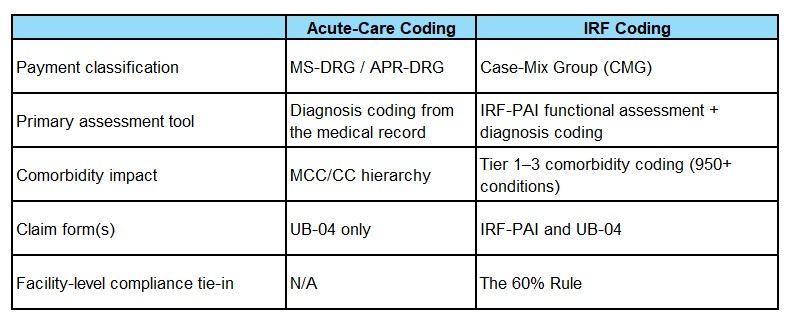
Acute-care coders are trained for MS-DRG and APR-DRG assignment. IRF coders work a different system entirely:
- CMG assignment — driven by the IRF-PAI functional assessment, not just diagnosis codes
- Comorbidity tier coding — over 950 conditions can shift a case into a higher-paying tier, but only when documentation and coding support it
- Dual claim responsibility — IRF coders work both the IRF-PAI (drives payment) and the UB-04 (the claim form)
- The 60% Rule — a facility-level compliance threshold tied directly to diagnosis coding accuracy, not just individual claim payment
A coder who’s excellent at acute-care DRG coding isn’t automatically equipped for IRF tier logic — it’s a distinct specialty that requires specific training.
At a Glance: Acute-Care Coding vs. IRF Coding
What’s at Stake
The Cost of Under-Trained IRF Coding
- Missed or under-supported comorbidity tiers directly reduce per-case reimbursement
- Documentation gaps between the PPS Coordinator, physician, and coding team create denial risk
- Facility-level 60% Rule compliance is jeopardized by inconsistent diagnosis coding — risking the facility’s IRF classification itself
- CMS continues to scrutinize IRF claims closely, making audit-readiness a standing requirement, not a one-time project
Who This Matters To
IRF Coding Affects More Than Your Coding Department
- HIM Directors & Coding Managers — need confidence that coders are actually tier-trained, not applying acute-care habits to IRF charts.
- PPS Coordinators — responsible for the IRF-PAI itself; coding accuracy either supports or undermines the assessment they’ve already built.
- CFOs & VPs of Revenue Cycle — feel tier-coding gaps directly in per-case reimbursement and denial rates.
- Compliance Officers — carry the facility-level risk if diagnosis coding patterns put 60% Rule compliance in question.
CBS works across all four — coding and auditing for the HIM and revenue-cycle side, training and education for the clinical and compliance side.
How CBS Helps
IRF Coding Services, Auditing, Training & Education
IRF-PAI & UB-04 Coding Services
Fully domestic, credentialed coders trained specifically in CMG assignment and tier-comorbidity coding — not generalists asked to cover an unfamiliar specialty.
IRF Auditing Services
Comprehensive chart reviews to confirm tier accuracy, documentation support, and 60% Rule compliance — identifying both under-coding risk and denial exposure before CMS does.
Training & Consulting for Your Current Staff
On-site or remote training to bring existing coding teams up to speed on IRF-specific tier logic, so facilities aren’t dependent on outside coders long-term.
Physician & PPS Coordinator Education
Guidance and training for the clinical side of the equation — physicians and PPS Coordinators whose documentation directly determines coding accuracy and 60/40 compliance.
Request an IRF Coding Assessment
How It Works
Why Facilities Choose CBS
Domestic Coders. Specialized Training. No Learning Curve on Your Dime.
- 100% U.S.-based coding staff — no offshore handoffs, no time-zone lag on urgent queries
- Specialists, not generalists — CBS coders working IRF charts are trained specifically for CMG and tier logic, not repurposed acute-care coders
- Flexible engagement models — full coding outsourcing, one-time audits, or staff training, depending on what the facility actually needs
- A partner across the full compliance picture — coding, auditing, and education under one roof, so facilities aren’t coordinating three separate vendors
FAQs
What is IRF coding and how is it different from acute-care coding?
IRF coding is based on the IRF-PAI functional assessment and CMS’s Case-Mix Group (CMG) payment system, rather than the MS-DRG/APR-DRG systems used in acute-care hospitals. It also factors in comorbidity tiers, which have no direct equivalent in acute-care coding.
What is the IRF 60% Rule?
The 60% Rule requires that at least 60% of an IRF’s patient population fall into specific CMS-qualifying diagnosis categories for the facility to maintain its IRF classification and associated payment rates. Accurate, consistent diagnosis coding is central to staying in compliance.
Why does comorbidity tier coding matter for reimbursement?
A qualifying secondary diagnosis, properly documented and coded, can move a case into a higher payment tier. Missing or under-supporting a tier-qualifying condition can mean a facility is paid less than the care actually delivered warrants.
Does CBS provide both coding and auditing for IRF facilities?
Yes. CBS offers IRF-PAI and UB-04 coding services, independent chart audits, staff training, and education for physicians and PPS Coordinators — so facilities can choose ongoing support, a one-time audit, or both.
Is CBS’s IRF coding services staff based in the U.S.?
Yes — CBS is 100% domestic, consistent with its coding staff across all service lines.
Can CBS train our existing coders instead of fully outsourcing IRF coding?
Yes. CBS offers training and consulting specifically for facilities that want to keep IRF coding in-house but need their current staff brought up to speed on tier logic and CMG assignment.
What should a facility have ready before an IRF coding audit?
Generally, recent IRF-PAI and UB-04 records, supporting clinical documentation, and access to relevant coding/compliance staff. CBS confirms specifics during the initial assessment based on the facility’s systems and scope.
Does CBS work with both freestanding IRF hospitals and hospital-based rehab units?
Yes — CBS’s IRF coding, auditing, and training services apply equally to freestanding IRF hospitals and IRF units operating within a larger acute-care hospital.
Call us today at: 610-442-2346 or e-mail us at: info@codingbillingsolutions.com